
Lane Rental schemes are expanding rapidly, placing new demands on both Authorities and Works Promoters to plan smarter, coordinate better, and minimise disruption on the busiest parts of the network. This article showcases how Aurora simplifies that challenge, bringing together powerful mapping, planning, and compliance tools that make managing Lane Rental clear, consistent, and efficient.
Aurora supports Authorities in implementing and governing schemes with confidence, while giving Works Promoters the insight they need to plan effectively, reduce costs, and deliver high‑performance outcomes. With transparent data, intelligent decision‑support, and real‑time operational visibility, Aurora helps every organisation work seamlessly within a Lane Rental framework and achieve better results across the network.
Introducing Lane Rental
Lane Rental is an approach that allows Highway Authorities to charge Works Promoters for occupying the busiest roads at the busiest times. With charges of up to £2,500 per day, Lane Rental is aimed at incentivising shorter durations, off‑peak working, and better coordination.
Lane Rental schemes historically have been implemented for those Authorities with high-traffic, disruption-prone roads and strategic routes, however schemes are fast becoming applicable across all Authorities.
Operating a scheme currently requires Secretary of State approval, although the Government has signalled that approval powers will be devolved to Mayors of strategic authorities under forthcoming legislation. As of March 2026, five Lane Rental schemes were live (Transport for London (TfL), Kent, Surrey, West Sussex, East Sussex), with a further 7 progressing through approvals and trial periods in 2026 (Merton, Enfield, Lambeth, Buckinghamshire, Camden, Oxfordshire, North Yorkshire Council).
Lane Rental Scheme Approval
The Department for Transport (DfT) guidance sets out how Authorities develop a business case, consult, and apply to introduce a Lane Rental scheme, including using the DfT cost–benefit analysis template. Approval is currently required from the Secretary of State, with updated guidance applying to bids from 5 January 2026 onward. Scheme proposals require a robust cost-benefit case, must evidence disruption and schemes cannot apply to more than 5% of a network. All schemes must also undergo stakeholder consultation.
Once complete, and approval is granted, both Authorities and Works Promoters must determine the most effective way for the implementation of these schemes, seamlessly integrating them into business processes and the Street Works solution to ensure the most successful outcomes.
Implementing your scheme in Aurora
Following approval, Authorities can begin to implement the approved scheme into their Street Works solution and their business processes.
Symology’s Professional Services consultants work closely with each Authority to ensure Aurora is configured in the most efficient, effective, and compliant way for their Lane Rental scheme. Through a collaborative onboarding process, our experts tailor Aurora to match the authority’s approved charge bands, governance rules, GIS data, and operational workflows, ensuring seamless alignment with both local policies and national DfT requirements. By optimising configuration from day one, our consultants help Authorities unlock the full value of Aurora, enabling consistent decision‑making, streamlined management, and confident delivery of their Lane Rental scheme.
This includes the following steps:
- Import your official Lane Rental streets, timings, charge bands and discount criteria; align with your permit scheme and Street Manager data.
- Load your authority GIS layers (traffic‑sensitive streets, strategic routes) and any Lane Rental data where applicable.
- Apply equal treatment of Utility and Highway Authority works and local rules for waivers/discounts to reflect your published scheme document.
- Configure surplus funds priorities, scheduled reports, so decision‑makers get a consistent view
Key Aurora features for Authorities
Aurora has been designed with Lane Rental in mind and includes a number of key features to help support the management of a Lane Rental scheme.
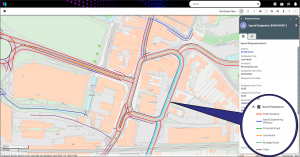 Lane Rental Map Layers
Toggleable layers for Lane Rental streets, times, and charge bands, overlaid with current and future works and diversion routes. Enables coordinators and planners to see at a glance where charges apply and when, identifying any potential traffic hotspots.
Full Transparency of Charges
Fully managed charge definitions for Lane Rental banding, enabling upfront transparency of cost versus duration, incorporating peak versus off-peak delivery and collaboration charge reductions.
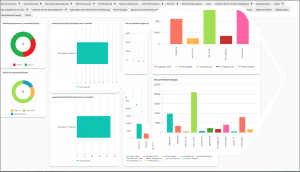
Dashboards for Compliance
Scheme specific dashboards and widgets for the management and monitoring of Lane Rental applicable works, enabling these to be assessed and monitored as a priority.
Surplus Funds Tracking
Full charge reporting to present total finance attributed to Lane Rental works for use in funding pipeline and award outcomes.
Reporting and Evidence Packs
One‑click DfT aligned Management reports for evaluation, such as changes in duration on traffic sensitive streets, consultation evidence snapshots, supporting quarterly and annual reviews and any scheme variations.
Cross-Boundary Planning
Aurora facilitates cross-boundary coordination to help avoid clashes and extended occupation of the network. With improved cross‑boundary visibility through the use of open data and Aurora’s inbuilt conflict checking, identification of collaboration opportunities offers alignment with HAUC Vision 2030 Consistency and Collaboration pillar.
For Works Promoters: Planning and delivering works on Lane Rental routes with Aurora
Whilst the introduction of a Lane Rental scheme is the decision of the Authority, subject to approval, this can have a significant impact on Works Promoter operations as they assess the implications on work planning, delivery and costs.
Aurora has embedded Lane Rental tools, aimed at assisting Promoters with the identification of Lane Rental locations and the cost implications of those works.
Key Features For Works Promoters
Prioritisation & Scheduling Tools
Aurora flags Lane Rental streets and sensitive windows during works creation, guiding planners toward off peak options, collaborative windows, or alternative traffic management to minimise charge exposure.
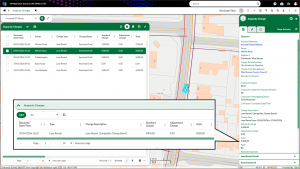
Potential Cost Visibility
Aurora can present an indicative charge estimate during design, so planners can compare scenarios, such as night vs day time, traffic management and duration. This supports engagement with the Authority, minimising last‑minute changes, and enables Street Works charges to be factored in at an early stage.
Conflict Detection
Aurora’s inbuilt conflict checking helps identify collaboration opportunities with other Promoters, alongside Lane Rental applicability. This helps to minimise rescheduling requirements and reduce overall occupancy, a behaviour DfT encourages and which many schemes reward.
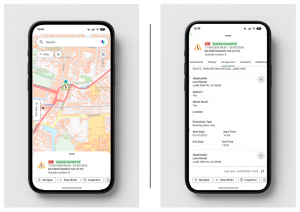 Mobile Field Tools
Capture timestamps and progress updates on‑site so potential overruns on Lane Rental streets are visible early and mitigations can be agreed in real time. This supports the shortening of durations and reducing the unoccupied time on site, whilst also assisting with works compliance through visibility of pertinent works information.
Overrun and Performance Dashboards
Live performance views highlight works approaching peak windows, at risk of overrun, or with alternative Traffic Management options that avoid peak‑period charges, giving supervisors the prompt to act before charges rise.
FAQs
Is Aurora only for authorities that are implementing a scheme?
No. Aurora supports Authorities operating Lane Rental schemes and Utilities working across both Lane Rental and non‑Lane Rental areas which becomes crucial as more Authorities join and rules vary locally. Lane Rental is expanding beyond early adopters. Authorities need robust tools to implement and govern schemes; Utilities need practical ways to plan, prioritise and deliver works efficiently across multiple, differing Lane Rental geographies.
How does Aurora help prove benefits of a Lane Rental scheme?
Aurora focuses on process and outcomes: shorter occupations, more off‑peak delivery, fewer clashes, improved journey reliability, exactly the benefits the DfT highlights and that Authorities must evidence in evaluations and bid updates.
Lane Rental is about changing behaviours to minimise disruption on the busiest parts of the network. Aurora provides a shared, transparent workspace for Authorities and Utilities to plan, manage and evidence that change with the mapping, decision support, dashboards and governance reporting needed to make schemes work in practice.